
When life does not pause
Caregiving while everything else continues.

My story is one of many. As I have learned, there are countless others still unfolding quietly around us.
I am a mother, caregiver, and product marketing leader who has spent the past year navigating serious illness inside my own family. I am writing to better understand what this experience asks of people, and what it might mean to support families going through it now and in the future.
Diagnosis arrives in the middle of life
Diagnosis doesn’t arrive into empty space. It tends to land in the middle of lives that are already in motion and demanding more than we feel able to give.
In my case, I was 15 weeks pregnant and deep in morning sickness. My toddler was approaching his second birthday, firmly in the trenches of sleep regressions. I was working full time at a tech startup, trying to keep pace with the usual urgency and expectation. Life already felt full.
Then my mom was diagnosed with glioblastoma.
The shift was immediate. One day we were on one of our many FaceTimes and I noticed she seemed slightly off, slower to respond, her face flushed, something about her presence different. Not long after, I was driving to the ER and hearing she had suffered a massive brain bleed. Within 48 hours we were discussing multiple tumors, urgent surgery, and a vocabulary none of us understood: high-grade glioma, resection, GBM.
A diagnosis can arrive overnight, and with it comes an uphill battle that begins immediately. Yet the rest of life continues at its same steady demand.
My pregnancy moved forward one slow week at a time. My son still woke through the night. Work still required focus. Two realities began unfolding at once: the progression of serious illness, and the steady momentum of ordinary life.
The emotional shock comes before understanding
In those early days, the emotional rollercoaster was difficult to describe. I remember sitting in hospital hallways feeling as though I was moving through something unreal. Conversations blurred together. Information landed but did not register.
I was trying to remain composed for my family, for my child, and for the baby I was still carrying, while confronting the possibility that we might be losing my mom.
Grief often starts with uncertainty, in the space between test results, in the attempt to hold hope and fear at the same time. There was very little time to process any of it. Practical demands arrived almost immediately.
Caregiving becomes a role overnight
Within days, I found myself stepping into responsibilities I had never anticipated. I was coordinating appointments, researching treatment options, translating unfamiliar medical language, and managing communication across family members who were also trying to make sense of it all.
A nurse handed us a sheet of paper with handwritten notes from a conversation outlining possible next steps. I remember staring at it for a long time, trying to understand how we were supposed to make these decisions so quickly.
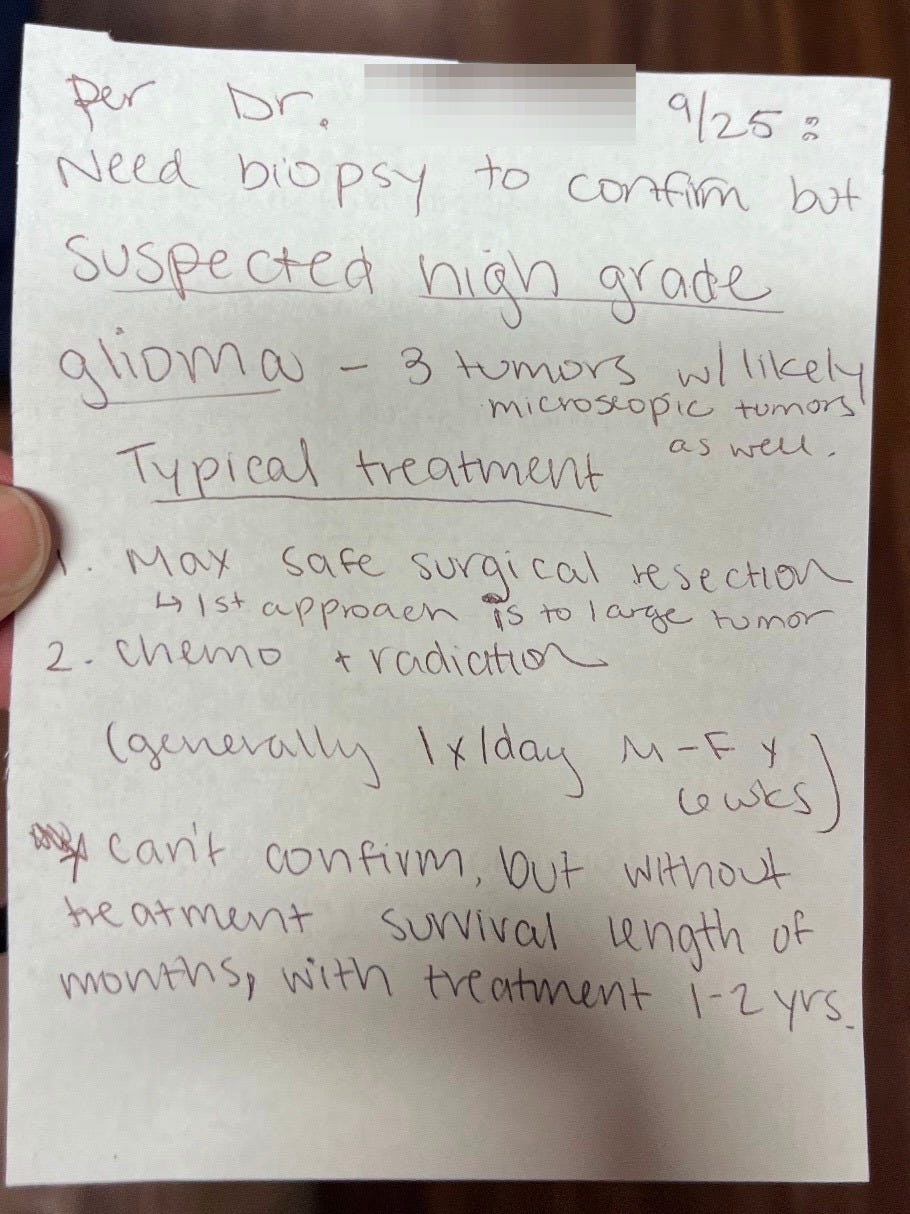
Life outside the hospital did not slow down. I rescheduled prenatal visits and sent anxious messages to my doctor about stress and sleep. My husband and in-laws worked to hold together routines at home while we reorganized our days around hospital visits and uncertainty.
Extended family began bringing trays of food to my parents’ house. The fridge filled quickly. We were deeply grateful, yet also aware that we did not even know what kind of help we actually needed.
At night I would look back at notes I had taken on my phone, trying to make sense of medication names, specialist referrals, and questions I thought I should ask. Often I did not know where to begin.
Living without a map
In the months that followed, that overlap became our normal. My mom’s condition shifted constantly. A miscalculated steroid dose one week, intense pain she could not clearly describe because of aphasia the next. We tried to map what the coming weeks might look like. Over time, we realized there was no reliable map.
Two days before my scheduled C-section, my mom experienced her first major seizure. It was the moment I understood she would not be there for the birth of my second child. She passed away four months later. By then we had been living inside cycles of crisis and adaptation for ten months.
The hidden world families begin to inhabit
Serious illness reshapes the lives of entire families and creates an invisible world that others rarely see. Clinicians are present for specific moments. Much of the experience unfolds elsewhere, in kitchens and cars and late-night searches for answers.
In online support groups, I saw similar questions surface repeatedly. Families trying to understand diagnoses, searching for financial resources, trying to hold their lives together while everything felt uncertain.
Even as it felt impossibly hard for us, I recognized how much privilege we had. I could step away from work. We had family support. We spoke the language. I often thought about the families who did not.
Serious illness arrives alongside the rest of life. It becomes life. Most of the work of carrying it forward happens in the hours between the moments that formally count as care. This is the part I now find myself unable to look away from.